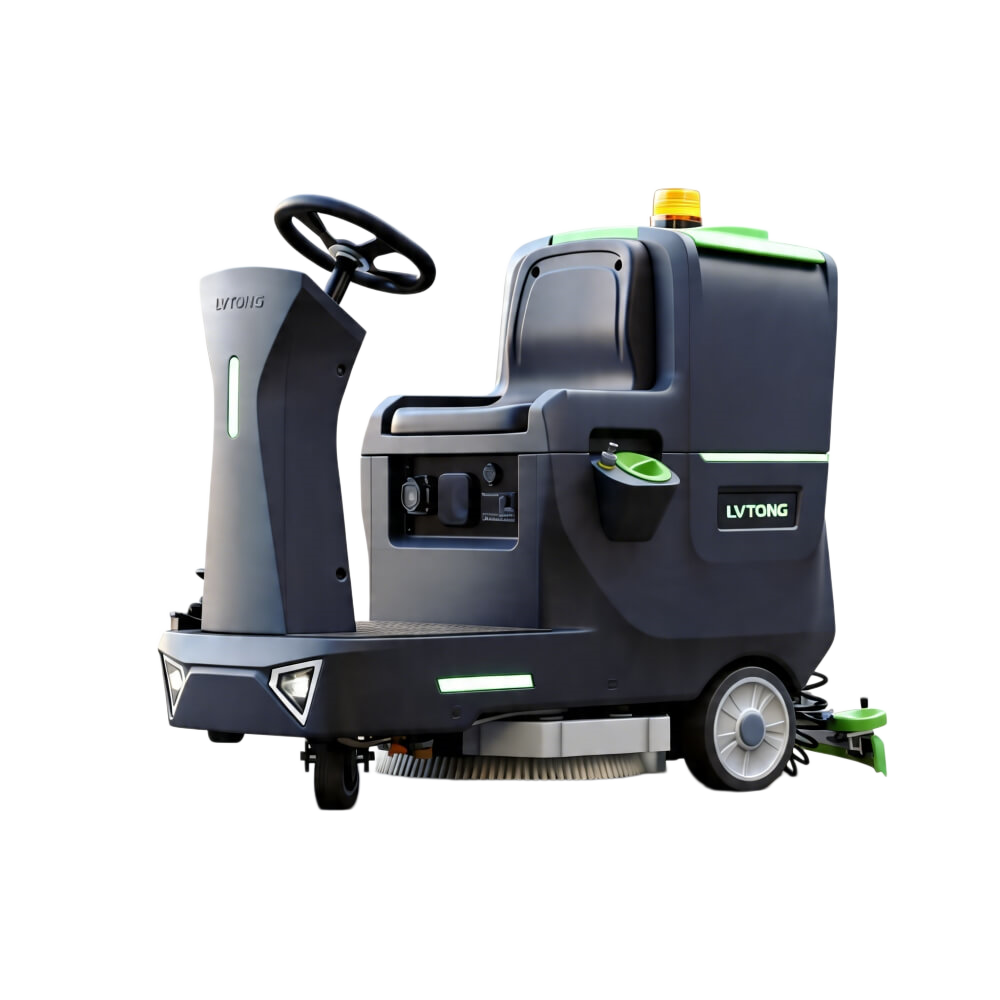
Industrial sweepers remove dry particulate waste by leveraging rotating cylindrical main brooms operating at 450 RPM alongside dual side brooms, which flick debris directly into internal hoppers capable of holding 350 liters of refuse.
Independent testing by the 2024 Facilities Maintenance Association demonstrates that matching floor scrubbers and sweepers to specific surface waste reduces daily labor expenditure by 42% across large distribution centers.
When facilities operate in dusty environments, airborne particulates like cement dust rated at 2.5 microns demand industrial sweepers equipped with polyester-felt panel filters that achieve a 99.9% filtration efficiency rating.
Filter degradation accelerates rapidly when moisture enters dry collection systems, causing paper elements to saturate and fail within 72 operating hours if proper pre-separation protocols are ignored.
Dry sweepers utilize mechanical flap-type hopper doors that pivot upward by 65 degrees to swallow bulky packaging materials, cardboard boxes, and wooden pallets without jamming internal vacuum fans.
Manufacturing plants processing over 1,200 tons of raw components weekly rely on these high-clearance intake systems to prevent debris bottlenecks along primary assembly corridors.
Heavy packaging remnants such as plastic strapping or steel banding require constant clearance checks because flexible fragments wrap around rotating broom spindles and induce motor stall within 15 minutes of continuous operation.
Maintenance logs from 2025 across 450 automotive plants indicate that entanglement downtime drops by 65% when operators utilize designated heavy-debris collection plates.
Transitioning from dry sweeping to liquid extraction requires auto scrubbers that dispense cleaning solution at flow rates between 1.5 and 4.0 liters per minute to properly saturate stubborn grease films.
Commercial kitchens dealing with animal fats maintain optimal slip resistance only when disk scrubbers apply downforce pressures exceeding 50 kilograms onto industrial floor tiles.
| Machine Type | Primary Waste Target | Average Operational Speed | Solution Tank Capacity |
| Industrial Sweeper | Dry dust, cardboard, metal chips | 8.5 km/h | N/A (Dry Hopper) |
| Auto Scrubber | Oils, chemical spills, liquid slurry | 4.2 km/h | 120 Liters |
| Combination Unit | Mixed wet and dry debris | 5.0 km/h | 90 Liters |
Operating a standard dry sweeper over standing machine coolant or hydraulic oil saturates internal paper filters and ruins bristles, requiring complete assembly replacement costing roughly $1,200 per service event.
Facility engineers in 2023 recorded that 78% of premature sweeper motor breakdowns originated from unauthorized liquid ingestion inside dry collection chambers.
Simultaneous wet-dry cleaning units utilize pre-sweep hopper attachments positioned 20 centimeters ahead of the wet scrub deck to isolate solid fragments before water touches the floor surface.
Field studies tracking 320 warehouse facilities prove that single-pass combination units reduce overall floor maintenance duration by 35% compared to traditional two-machine deployment schedules.
| Debris Category | Recommended Machine | Operational Risk If Misapplied |
| Fine Dry Powder | High-filtration sweeper | Airborne dust dispersion, filter blinding |
| Industrial Sludge | Heavy-duty floor scrubbers and sweepers | Squeegee clogging, vacuum motor flooding |
| Metal Turnings | Mechanical sweeper | Punctured solution tanks, hose tears |
Squeegee blades constructed from oil-resistant polyurethane maintain constant ground contact via parabolic linkage arms that adjust automatically across uneven concrete joints and expansion gaps.
Precision suction tracking ensures that 98% of liquid slurry is recovered in a single pass, leaving warehouse floors completely dry and safe for forklift transit immediately afterward.