A sample can show whether one item matches a buyer's design, but it cannot by itself establish that a full shipment will be consistent. Buyers should compare three complementary methods: approve a clearly identified reference sample, check controls during production, and select finished goods using a documented lot-sampling plan. The right combination depends on the material, the consequence of failure, and the test method required for the product.
Key takeaways
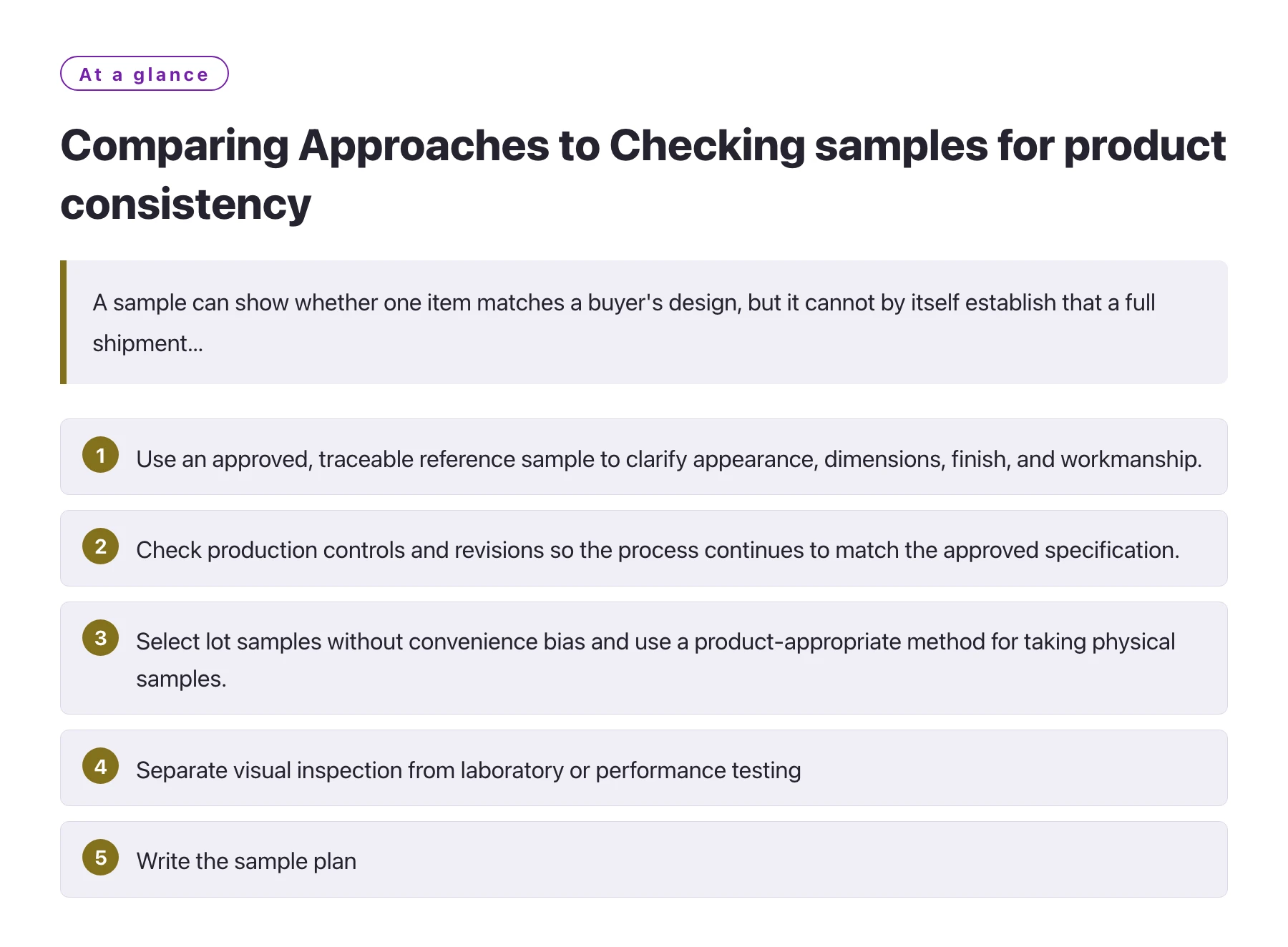
- Use an approved, traceable reference sample to clarify appearance, dimensions, finish, and workmanship.
- Check production controls and revisions so the process continues to match the approved specification.
- Select lot samples without convenience bias and use a product-appropriate method for taking physical samples.
- Separate visual inspection from laboratory or performance testing; each answers different questions.
- Write the sample plan, acceptance limits, records, and response to failure into the purchase documents.
Building materials can vary in color, dimensions, surface finish, composition, or measured performance. Some variation is inherent to the material or manufacturing process; other variation points to a change in source, settings, handling, or quality control. Buyers get a clearer picture when they treat sample approval as one checkpoint in a larger evidence plan, rather than a promise that every item in a future lot will be identical.
Start with a representative, identified reference sample
A reference sample is useful for agreeing what the buyer and supplier mean by the specification. Record the product name, material or grade, color reference, dimensions, finish, production route, date, and revision. Photograph the sample under consistent conditions and keep the physical sample where possible. If the sample is a mock-up or handmade prototype, label it as such; its process may differ from the production line that will make the order.
List what the reference can and cannot demonstrate. A tile sample can help assess shade, edge quality, surface appearance, and dimensions, while a small cut piece may not represent the condition of every pallet or establish performance under a specified test. A board sample may show surface finish but not all internal layers or the moisture behavior of a complete panel. Ask the supplier to identify any properties that need a separate test or record.
Both parties should keep the same reference or a jointly signed record. If a buyer approves a revised sample, retire the earlier revision explicitly to avoid mixing standards during production.
Compare first-article checks with in-process controls
A first-article check examines an early production item or initial run against the approved requirements. It can catch a wrong color code, dimension, edge profile, packaging method, or machine setting before a large quantity is completed. It is most useful when the item is identified and the checked characteristics are listed. A verbal statement that the first pieces 'look good' leaves no record of which requirements were checked or what result was accepted.
In-process checks answer a different question: whether the production route continues to stay within the agreed conditions. Ask where measurements or visual checks occur, how records identify the production date or lot, who handles a result outside tolerance, and how changes to materials or settings are approved. A process can change after the first article, so an early approval should not silently replace later checkpoints where the risk warrants them.
Production records should connect the observed result to the product and lot. If the supplier uses an internal code, request a simple cross-reference to the order, line, material batch, or production date. The goal is to make a reported issue traceable enough to investigate, not to gather paperwork that cannot be tied to the goods.
Use lot sampling to avoid selecting only easy examples
Finished-goods sampling can reveal defects or variation in a lot, but the outcome depends on how items are selected and what is inspected. Choosing only top cartons, samples set aside by the factory, or the most accessible products can introduce bias. ASTM's D3665 practice addresses random selection of locations or timing for construction-material samples to reduce unintentional selection bias, and points users to product-specific methods for the physical sample procedure.[1] Buyers should select an applicable method for the material rather than assuming one sampling method fits every product.
For a shipment packed across pallets, production dates, or material batches, consider whether the inspection plan should cover those different parts of the lot. Record how the lot is defined, who selects the sample, where it comes from, and whether the inspector can reach all relevant units. If the test requires a sample to be cut, mixed, conditioned, or transported in a particular way, agree on the procedure and chain of identification before the goods are disturbed.
Sample-based inspection is evidence about the selected units under the chosen plan. It does not guarantee that every untested unit is conforming. The purchase documents should specify how a failed result affects the lot, whether a repeat test is allowed, who pays for it, and what happens to goods that remain outside the requirement.
Separate visual review from technical testing
Visual inspection is appropriate for observable characteristics such as color differences, surface marks, edge chips, cracks, labeling, or packaging damage. Use defined defect categories and representative lighting or viewing conditions where appearance matters. Include a comparison to the approved sample and distinguish critical issues from minor cosmetic variation. Without shared definitions, two inspectors may classify the same condition differently.
Performance properties require a suitable test method, equipment, and sometimes a qualified laboratory. Depending on the material and intended use, a buyer may need evidence about composition, strength, moisture, dimensional stability, fire behavior, emissions, or another property. The relevant method and legal requirement depend on product type and destination market; confirm them before ordering. A supplier datasheet or certificate should be checked against the specified product, production site, test date, and scope, and it should not be described as proof of a different property.
Where an external test is needed, agree which party chooses the laboratory, how the tested sample is identified, whether the test is destructive, and how results will be shared. If multiple parties rely on the result, preserve the sample and report details so they can review the same evidence.
Compare the options by risk and decision value
Reference-sample approval is relatively simple and helps settle design intent; it is weak evidence about future production consistency. First-article and in-process checks provide information about how the order is being made; they require access to relevant records or production stages. Lot sampling gives a view of selected finished goods; it remains limited by the sample plan and cannot replace a technical test. A laboratory test can answer a defined performance question, but it may take time, cost more, or require destructive sampling.
Rather than applying every method to every purchase, identify the failure modes that matter. A low-consequence appearance preference may need a signed sample and defined visual criteria. A building component with safety or regulatory implications may require product-specific evidence and a qualified test method. For mixed lots or multiple production dates, selecting samples across the lot may be more informative than repeatedly inspecting one convenient carton.
For sourcing teams that need help coordinating supplier communication, sample records, and inspection access, review building materials wholesale sourcing against the tasks and decision rights in your procurement plan. Keep technical requirements and final acceptance criteria explicit in the order regardless of who coordinates the checks.
Put the sample plan into the purchase record
Before production starts, write down the approved sample reference, relevant product revisions, characteristics to inspect, sampling method, test method, acceptance limits, inspection stages, and records the supplier must provide. Identify the lot definition and the person authorized to accept a deviation. If a test or inspection fails, specify whether the supplier must stop, sort, rework, replace, or submit a new sample, and what evidence is needed before release.
Keep changes visible. If a material source, manufacturing location, component, formulation, or process changes, decide whether it requires notice, a revised sample, repeat testing, or buyer approval. A new sample that quietly replaces the approved standard can make later inspection inconsistent. Document the reason and effective date for each revision so the buyer and supplier can match decisions to the correct order and production lot.
Sources
Frequently asked questions
Does approving a sample mean the whole order will match it?
No. Approval clarifies the reference condition, but consistency depends on production controls and how the finished lot is checked. Put those checks and the response to variation into the purchase record.
Is a random sample always enough to accept building materials?
No. Random selection can reduce selection bias, but the sample size, physical collection method, test, and acceptance rule must fit the product and decision. Some properties require a specific standard or laboratory test.
Should the buyer inspect every unit?
That depends on the product and risk. Some characteristics can be checked by sampling, while critical features may need process controls, defined testing, or additional inspection. Agree the plan before production.
What should happen when a sample fails?
The contract should state whether production pauses, a lot is held, a repeat test is permitted, or goods must be sorted or replaced, and who bears the associated cost.