PV Cable Standards: TÜV 2PfG 1169, EN 50618, IEC 62930
Three names dominate a European photovoltaic cable specification, and they appear together on one product page: TUV 2PfG 1169/08.2007, EN 50618:2014 and IEC 62930. The page also states the numbers those schemes are used to check, including a rated DC voltage of 1.8/1.8 kV, a finished-cable test of 6.5 kV AC for 5 minutes and a bending radius of 4 times the outer diameter. KUKA CABLE, a cable manufacturer in Jinshan District, Shanghai, publishes all of them on its solar pv cable pages.
Key takeaways
- The 1500 V solar cable page names TUV 2PfG 1169/08.2007, EN 50618:2014 and IEC 62930 in one list.
- Conductor is tinned copper, class 5 flexible to IEC 60228; insulation and sheath are electron-beam cross-linked XLPO described as low smoke halogen free.
- Checks the page names: a 10 kV spark test as the cable runs, and 6.5 kV AC at 50 Hz applied to the finished length for 5 minutes.
- A count of more than 30 certificate types is listed there — TUV, IEC, CE, SAA and UL among them — and the UL entry is marked as still being updated.
Reading the three names on one datasheet line
A standards list on a cable page is not decoration; it tells a designer which test regime the numbers beside it belong to. The manufacturer prints the three names in a single row: TUV 2PfG 1169/08.2007, EN 50618:2014 and IEC 62930. The same page then states the construction those regimes are applied to, so the reader can check that the copper, the insulation and the sheath match what the standard expects rather than only that a certificate exists.
That construction is published in plain terms. The conductor is tinned copper of class 5 flexibility according to IEC 60228, which describes a finely stranded, flexible rope rather than a solid core. Insulation and sheath are both XLPO, cross-linked by an electron beam and described as low smoke halogen free, with black and red as the published sheath colours. For a cable that will be pulled through trays and bent around mounting rails, the flexible conductor class is the part of the specification that decides how the cable behaves on site.
What the three regimes are used to check
The European standard sets the ageing requirement that most quotations quote back: EN 50618 requires an elongation before ageing of more than 125%, and the manufacturer states that its photovoltaic cables typically run about 20% above that requirement, reaching up to 185%. That is the clearest example of how a standard turns into a number a buyer can compare. The second regime is the TUV scheme, which the site describes as the starting point for a certificated cable; the pages associate it with electrical safety, a low fire risk and stable performance for more than 25 years. The third is IEC 62930, named on the same row as the international counterpart of the European document.
The site adds a regional layer on top, set out on its solar cable topic page. It highlights CPR fire rating as a European construction-products requirement and an AD8 waterproofing rating, and lists TUV EN 50618 and PV1-F, UL 4703 and IEC 62930 as the common international certifications for photovoltaic cables. A separate product page exists for UL 4703 solar PV wire, which is the document a North American project will ask about first.
The temperature figures that travel with a standard
Standards are silent about the daily conditions of a specific site, so the manufacturer publishes its own limits as well. The 1500 V solar cable page gives an ambient range of −40 °C to +90 °C, and adds two short-circuit values, +120 °C sustained for 20,000 hours and +250 °C for 5 seconds. Those figures sit beside the standard names because they describe the same compound: an electron-beam cross-linked XLPO that holds its shape at the top of the ambient band and tolerates a brief fault without losing the sheath.
The chart below belongs to this temperature question rather than to the standards list, and it is reproduced here as the manufacturer's published figures on that separate point.
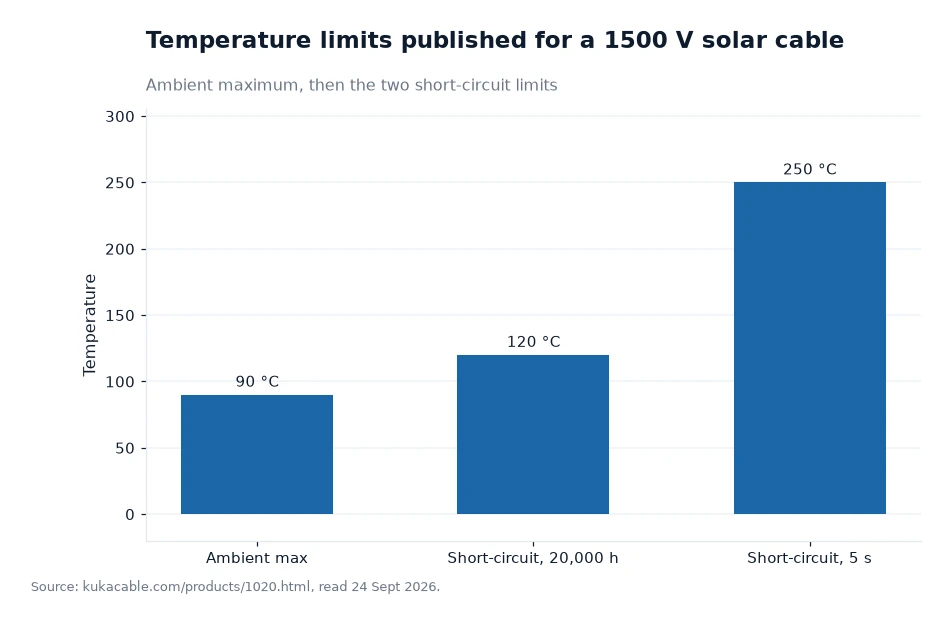
Read the three bars as three different questions. The first is a design condition that applies every day, the second is a slow overload that the cable is described against for a very long period, and the third is a fault that protection is expected to interrupt within seconds. A specification that quotes only "90 °C" and stops there has quoted one third of the published picture.
Where a standards claim is thin
A page can name a standard without saying which model was tested against it, and that is the gap a buyer should close in writing. The useful questions are short. Which exact model and cross-section does the certificate cover? Which year and revision of each standard is written on the certificate? Is the certificate issued for the finished cable or for a component? Does the certificate still stand, or is it in the process of being updated, as the site says of its UL document?
The manufacturer's laboratory has been running since December 2015 and is described as an ISO/IEC 17025 laboratory, which is one reason the test values can be quoted with a place and a date rather than as a general claim. The published test list includes water resistance, UV accelerated weathering, abrasion, cold bending and cold elongation, tensile testing after ageing, solderability, static flexibility and construction and dimensional checks.
| Standard or scheme | Where the pages carry it | What the pages associate with it |
|---|---|---|
| TUV 2PfG 1169/08.2007 | 1500 V solar cable page | Named in the standard row of the product data |
| EN 50618:2014 | 1500 V solar cable page and laboratory page | The regime behind the elongation requirement of more than 125% |
| IEC 62930 | 1500 V solar cable page | The international counterpart named in the same row |
| UL 4703 | Product model page and certificates page | A photovoltaic wire model, with the UL document described as being updated |
| CPR | Solar cable topic page | A regional fire-rating requirement the site highlights |
| AD8 | Solar cable topic page | A waterproofing rating the site highlights |
Worked example
Take the two voltage numbers on the same page and put them side by side. The cable is rated DC 1.8/1.8 kV, and the finished cable is tested at 6.5 kV AC for 5 minutes. Dividing the test level by the rated DC value gives 6.5 ÷ 1.8 = 3.6, so the routine production test sits at about 3.6 times the declared rating; that division is my own arithmetic on the published figures.
Compare the same test level with a 1500 V system and the margin looks different again: 6.5 kV ÷ 1.5 kV = 4.3. Both figures are mine, and both assume the test voltage printed on the page is the one applied to the finished cable, which is what the page states. The point is not that a larger number is better; it is that a specification should quote the rating and the routine test together, because a buyer cannot compare a test level with a system voltage unless both are written down.
Frequently asked questions
Do TUV, EN 50618 and IEC 62930 cover the same thing?
They are three different documents used in different markets, and the manufacturer's pages name all three on the 1500 V solar cable specification. The practical step for a buyer is to state the market the project is in, then ask for the certificate that covers the exact model and cross-section being offered rather than accepting a general standards list.
What does the site say about the CPR and AD8 ratings?
The site highlights CPR as a fire-rating requirement and AD8 as a waterproofing rating, alongside the certificates page list of more than 30 types including TUV, IEC, CE, SAA and UL. Classification values are not printed on the pages read, so both ratings should be confirmed against the certificate for the offered model.
What to send with a standards-based enquiry
Put four lines in the enquiry: the standard you require with its year, the cross-section and conductor class, the temperature and voltage values you expect to see on the datasheet, and a request for the certificate that covers the model offered. Ask for the elongation figure before ageing so that the offer can be compared with the published 185%. The site does not publish unit prices, minimum order quantities, lead times or warranty terms, so those belong on the quotation, not on the page.
Read on 24 Sept 2026, the standard numbers and temperature limits quoted above sit on the manufacturer's own website pages[1].