Warning signs in custom perfume manufacturing are rarely dramatic. Suppliers that turn out badly are usually competent at the pitch and weak in the details: they quote before they understand the scope, they are vague about who owns the formula, and they accept a brief without pushing back on anything. For a retailer's own brand, those small omissions cost more than in other channels, because the retailer is both the customer and the brand on the label. The most useful screening tool is written answers, compared across suppliers, read twice.
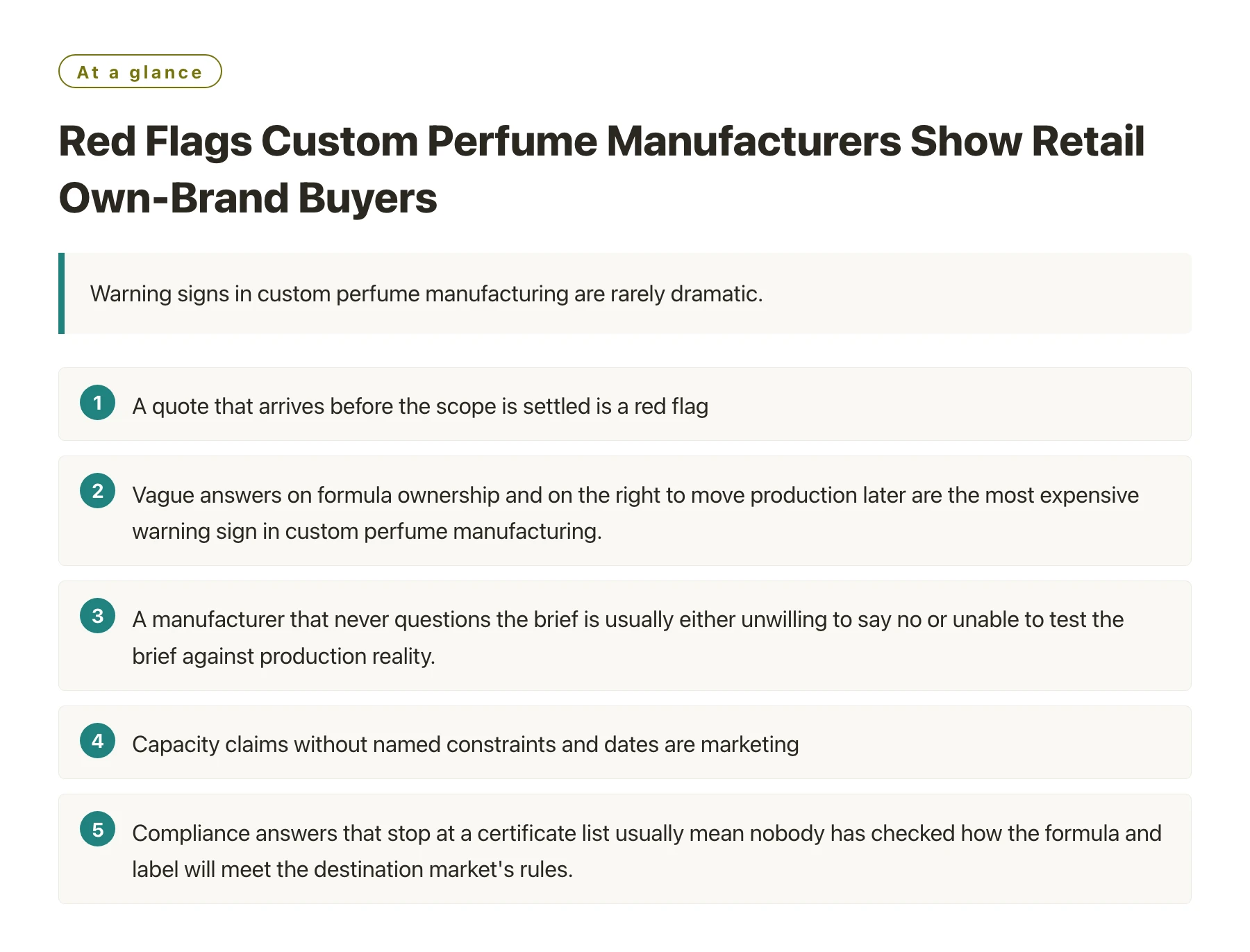
Key takeawaysA quote that arrives before the scope is settled is a red flag, because it means the number will move once the scope is agreed. · Vague answers on formula ownership and on the right to move production later are the most expensive warning sign in custom perfume manufacturing. · A manufacturer that never questions the brief is usually either unwilling to say no or unable to test the brief against production reality. · Capacity claims without named constraints and dates are marketing, not information a retailer's own brand can plan against. · Compliance answers that stop at a certificate list usually mean nobody has checked how the formula and label will meet the destination market's rules.
Most buyers screen suppliers with a call, a portfolio and a price. That order is convenient for the supplier and expensive for the buyer, because the cheapest moment to detect a mismatch is before sampling, and the cheapest medium to detect it in is writing.
The flags below are grouped by where they appear: in the quote, in the answers about ownership, in the response to the brief, in capacity language and in compliance. None of them proves a supplier is bad. Each one is a question that needs a better answer before the programme proceeds.
Why warning signs surface in writing rather than in meetings
A meeting rewards fluency. A written question rewards specificity, and specificity is the thing a retail own-brand programme actually needs. When the same five questions go to five suppliers and come back as five very different documents, the differences tell you more than any presentation will: who read the brief carefully, who has run this kind of programme before, and who is repeating a template.
It also creates a record. If a supplier later claims that a requirement was never communicated, the written exchange settles it without a conversation. Buyers who run custom perfume manufacturing programmes this way tend to describe the process as slower at the start and considerably faster afterwards.
Working with a partner such as Xuelei does not remove the need for this screening, and it should not. The point of the questions is to let a good supplier demonstrate that it is good, in its own words, before money is committed. The volume of supplier interest is part of the reason to be careful: own-brand and private-label beauty ranges have drawn sustained attention in market reporting, which means more factories now advertise own-label fragrance capability than did a few years ago [4].
Five red flags, and the question that tests each one
The flags are ordered by how much they cost when they turn out to be real.
Red flag 1: the quote arrives before the scope
A unit price delivered in the first reply, before anyone has established the pack, the fill, the decoration or the market, is a placeholder. It will move. The question that tests it is simple: ask for the quote broken into development, compounding, filling, components, decoration, testing and packing. A supplier that can itemise has costed the project; a supplier that cannot has costed a bottle. This matters especially in white label fragrance manufacturing conversations, where the boundary between the supplier's library and your own development changes the price more than any volume discount will.
Red flag 2: ownership is answered with a shrug
Questions about formula ownership, exclusivity and the right to move production later should produce a precise answer, ideally one that quotes the wording of the clause. Hesitation here is not modesty. Intellectual property arrangements in manufacturing are a settled subject with standard structures, and a supplier that has not thought about them is a supplier that has never had to defend them [1].
Red flag 3: the brief is never questioned
A supplier that accepts every element of a brief without comment is telling you something. Either it has not tested the brief against production reality, or it prefers not to deliver bad news early. Expect at least one pushback: a note about a material that behaves badly at high concentration, a pack that will not survive the intended fill, or a launch date that leaves no room for resting. Buyers who are choosing a factory for a perfume brand should read the absence of pushback as a warning, not as flexibility.
Red flag 4: capacity claims without names or dates
Language about large capacity, flexible lines and fast turnaround is meaningless without constraints. The useful version sounds different: which line, what minimum and maximum run, what the changeover cost is, and which weeks are already committed. Ask when the next free slot is and watch whether the answer is a date or a description.
Red flag 5: compliance answers that stop at certificates
Certificates describe a management system. They do not answer whether a specific formula can be sold in a specific market, which is the question a retailer's own brand is actually asking. Request the restriction list the formula was built against, the allergen data and the labelling approach, and check the ingredient rules for the destination market rather than accepting a general assurance [2]. A supplier that treats compliance as a design input will have those documents; one that treats it as paperwork will send a certificate.
The flag that outweighs the others
If one signal has to carry the most weight, it is how a supplier behaves when a question is inconvenient. Ask for a reference batch record, ask what went wrong on the last colour match, ask who signs the release. Suppliers that answer plainly, including about their own errors, are usually the ones that manage a problem rather than hide it. Suppliers that deflect are a risk even when every other indicator is strong.
Industry practice supports this reading: the technical capability of contract manufacturers is broadly comparable at a given price band, and the difference between a good and a bad programme is usually process discipline rather than equipment [3]. That is why the screening conversation is worth more than the factory tour.
Before signing, also make sure the questions have been asked in a form that can be compared. Xuelei Fragrance sets out the checks that produce a written answer, and using one questionnaire across all shortlisted suppliers turns five conversations into a single, readable comparison. The discipline is the same as choosing the right factory for a perfume brand: a comparison is only as useful as the consistency of the questions behind it.
The final test is inexpensive. Ask the supplier to describe one programme that went wrong, what caused it and what changed afterwards. A supplier with no such story either has not run many programmes or is not answering the question, and both are reasons to keep looking.
Red flags in custom perfume manufacturing are mostly absences: no scope breakdown, no ownership clause, no pushback on the brief, no dates behind the capacity claim, no compliance documents beyond a certificate. Absences are easy to miss in a meeting and obvious in a written reply.
Sources
- WIPO — World Intellectual Property Organization —— The UN agency for intellectual property; resources on industrial design and patent protection relevant to product and packaging design.
- EU CosIng — Cosmetic Ingredient Database (European Commission) —— The European Commission's CosIng database of cosmetic ingredients, listing ingredient functions, restrictions and labelling requirements under EU cosmetics law.
- Cosmetics Europe —— The European trade association for the cosmetics and personal care industry, publishing guidance, positions and market information.
- Mintel Press Centre —— Mintel's press releases on consumer and beauty market research, including fragrance and personal care trend reporting.
Frequently asked questions
What is the single biggest red flag when choosing a custom perfume manufacturer?
Evasive answers about formula ownership and exclusivity. Almost every other problem can be fixed with time and money; an unclear ownership position can prevent a retailer's own brand from moving production, extending a line or selling the business later.
Should I be worried if a supplier quotes very quickly?
Rapid reply is a good sign; a complete price without a settled scope is not. Ask for the itemised version. If the fast quote survives itemisation, nothing is wrong. If the number moves substantially once the pack and volume are confirmed, the fast quote was a placeholder.
Is a supplier that questions my brief being difficult?
Usually the opposite. A pushback at brief stage is cheaper than a failure at filling stage. The useful signal is whether the pushback comes with an alternative, for example a different concentration, pack or schedule, rather than a flat refusal.
How do I check compliance claims for a retail own brand?
Ask for the ingredient restriction list, allergen data and the labelling approach in writing, then verify the destination market's requirements independently. Certificates confirm a system; they do not confirm that a particular formula and pack can be sold in a particular country.
Are these warning signs the same for OEM and ODM programmes?
The flags overlap, but the emphasis shifts. On an OEM programme the specification is yours and the risks cluster around production control. On an ODM programme the supplier also owns development, so ownership, exclusivity and the depth of the formulation work matter more.