20 Best NSFW AI Characters: What a Trend List Actually Measures
A top-20 list is a measurement, not a verdict. On 22 September 2026 the leading card on the CrushOn.AI trends page carried 24.3M views and 7.1K favourites, a favourites-to-views ratio of roughly 0.029% — and that gap between attention and deliberate saving is the most informative thing the page shows.

Key takeaways
- The list holds twenty characters and its weekly rankings rebuild every Thursday, so any position is a seven-day claim.
- Views measure exposure and favourites measure returns: 7.1K favourites on 24.3M views works out at about one save per 3,400 views.
- Tags such as Unfiltered, Submissive, Fictional, OC and Female do more filtering work than the ordering does.
- Sizing the list at 75 seconds per card costs about 25 minutes — roughly 10% of a four-hour monthly habit, under 3% of a sixteen-hour one.
What a platform-curated list optimises for
A list published by the platform is not a review round-up. It is a compression of signals the platform already records, and the cards show which ones: a view counter, a favourite counter, a tag row and an author credit. Ordering follows those counters, so the list optimises for volume of attention first and depth of interest second.
That ordering explains a pattern which looks wrong at a glance. The leading card's 24.3M views against 7.1K favourites is a ratio of about 0.029%. Takara's 4.7K favourites against 18.2M views is 0.026%. Eva's 2.8K against 19.1M is 0.015%. If the sort key were engagement rather than reach, those three would not necessarily sit in the order shown. Nothing on the page is broken; the list simply answers a different question from the one most visitors bring to it.
The ceiling is worth naming too. Twenty slots cannot represent a catalogue, so a missing card is not a judgement. Positions describe a slice, and the slice is whatever the counter ordering produced on the day the page was read.
Where the list helps, and where it misleads
As a shortlist it works well. Twenty named characters with tags and creator credits are a better starting point than an empty box, and the tag row carries real information: Unfiltered, Submissive, Fictional, OC and Female describe the shape of a character before you open anything.
As a ranking of quality, the ordering fails for three predictable reasons. A card can sit among the most-viewed NSFW AI characters on the page and still be a poor match for you, which is why reach and fit deserve separate treatment. Counters accumulate across a card's whole life, so an older card carries an advantage that has nothing to do with current interest. Favourites are far rarer than views, which means a small shift inside a four-digit counter moves the ratio a long way. And the page is a snapshot; read it next week and the ordering will have rebuilt.
The practical consequence is simple. Crushon publishes weekly boards on a Thursday clock, and reading their order as a promise rather than a snapshot is where most disappointment starts. If you want a card that holds attention rather than one that gathers it, do the division yourself. Write both counters down, divide favourites by views, and compare the result with the average of the twenty cards in front of you. A card at 0.026% against a page average near 0.02% is performing better than its position suggests, and a card at 0.015% is performing worse.
A cheap way to size the whole list
Browsing twenty cards is not the expensive part of a session; the first real message is. Treat the pass as a filter and the arithmetic becomes small enough to plan around.
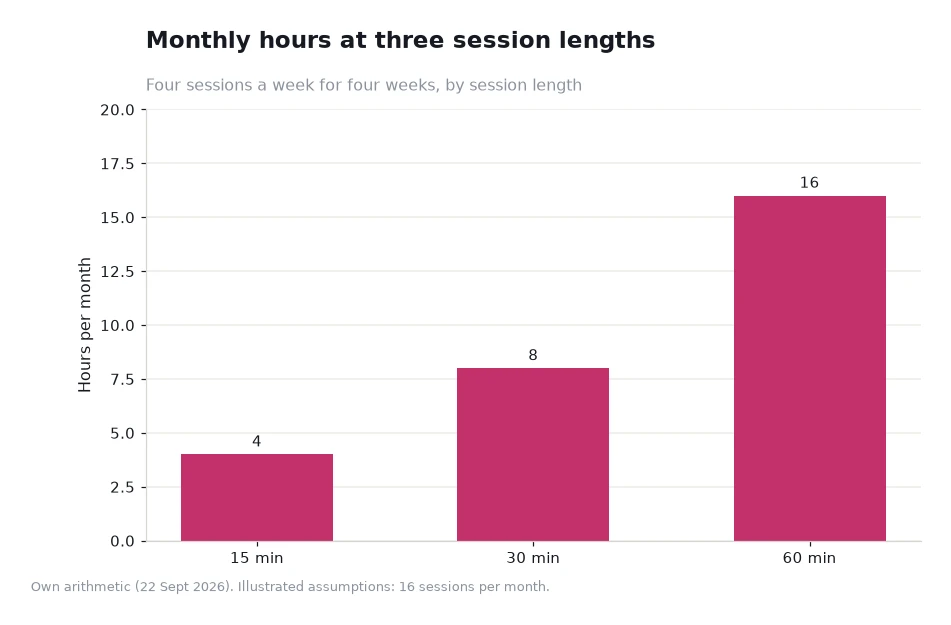
Take 75 seconds per card as an illustrative assumption rather than a platform metric. Twenty cards take 25 minutes. Spread that over 16 sessions in a month — four a week for four weeks — and the pass costs roughly 1 minute 34 seconds per session. Measured against session length the same 25 minutes behaves very differently: at 15 minutes a session the month totals 4.0 hours and the pass is about 10% of it, at 30 minutes the month totals 8.0 hours and the share falls to about 5%, and at 60 minutes a session the month totals 16.0 hours and the share drops to roughly 2.6%.
| Signal | What it measures | What it cannot tell you |
|---|---|---|
| View counter | Cumulative exposure across the card's life | Whether the card is drawing interest this week |
| Favourite counter | Deliberate saving, such as 7.1K against 24.3M views, or 0.029% | Whether the person who saved it ever came back |
| Tag row | Broad classification: Unfiltered, Submissive, Fictional, OC, Female | Whether one particular tag matches your taste |
| Author credit | Which creator published the character | Anything about that creator's other work |
| Position 1 to 20 | This week's ordering, rebuilt every Thursday | Quality, or the reason a card is absent |
What a wrong first pick actually costs
Opening a card spends nothing but minutes, and minutes are the only budget a text conversation really uses. Take an illustrative pattern of ten messages a day: that is roughly 300 messages a month whether they carry a good exchange or a thin one. What a useful list should help you answer is how quickly a character earns the next message.
A yardstick worth keeping is the ratio of saves to openings. Open three cards a week and save one, and a library grows by four or five entries a month; open three and save none, and the month produced nothing to return to. Neither figure is a platform metric — both are your own bookkeeping, which is precisely why writing counters down beats trusting a position.
Turning the list into a queue
Three steps keep the page useful without letting it decide for you. Filter first so the twenty cards match the sort of character you actually want to talk to, then take the ratio, then test one candidate properly instead of opening five in a row.
Used that way the collection behaves like a queue. Start on the platform's nsfw ai chat board, note the three cards whose favourites-to-views ratio sits above the page average, and give one of them a full session rather than fifteen seconds. When all three have had a turn, keep the best or look again. If twenty cards feel too narrow, the character search page filters the wider catalogue directly instead of waiting for the list to move, and the content removal policy sets out what happens when a card is reported for breaking the site's rules.
One habit keeps the queue healthy: save what survives its first session. Saving is the exact signal the trend page counts, and a personal library built on tested characters ages better than one built on positions.
Frequently asked questions
Is the top twenty a quality ranking?
No. It orders cards by counters that reward accumulated attention, so an older card can sit above a newer one with a stronger favourites-to-views ratio.
How often does the list change?
The weekly rankings rebuild every Thursday, so a position describes one week rather than a permanent standing.
Which counter should a reader trust more?
Favourites, but only as a ratio. 7.1K on 24.3M views is 0.029% and 2.8K on 19.1M is 0.015%; the division is the signal, not the raw number.
Read the list as a queue, not a verdict
Pick a filter, divide two counters, and give one candidate a real session. That costs about 25 minutes a month at the pace used above and returns a shortlist you chose rather than one you inherited. Re-read the page after a Thursday refresh, because a card climbing on ratio rather than on reach usually deserves a second look.
Data and sources: the card counters shown on the CrushOn.AI trends page[1], read 22 Sept 2026. The 75-second card pass and the session-length hours are illustrative assumptions, not platform data. This guide is meant for readers of legal adult age, 18 or over.